I can still hear it. That particular ping when a squash ball catches the strings just right, mid-court. I wasn't the one coaching, I was the one standing behind the glass with a notebook, listening to the coaches who actually knew the game. We call them SMEs. Unearthing how they'd take someone from "can hit the ball" to "can read the game," and why they made the decisions they made at each stage. My job was never to coach anyone.
I never once thought that was a skill. But fast forward to the present day and I'm using the same techniques and approaches to build pathways in financial services, energy sector and higher education. Whatever industry it is, a pathway is a pathway.
An academy isn't a platform, it's a route
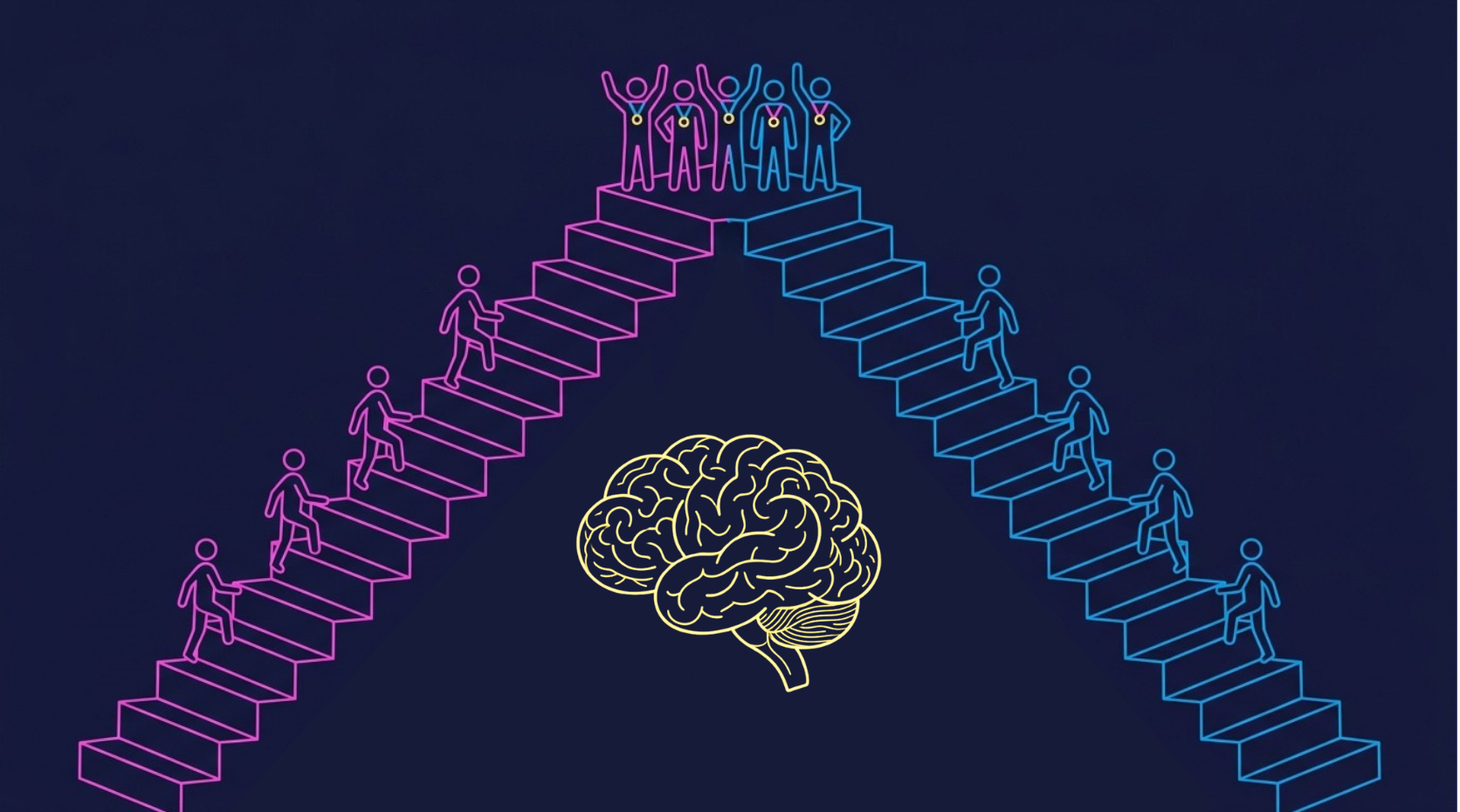
When people ask me what an academy actually is, they're usually expecting an answer about software. LMS, video library, maybe some quizzes. That's not it, or at least it's not the interesting part. An academy is a route from A to Z, and the LMS is one stop on it, not the destination.
The actual pathway, done properly, pulls in everything: the LMS for the things that scale, face-to-face for the things that don't, blended sessions where they overlap, coaching, mentoring, formal assessment, compliance where the sector demands it, sales process training where the business needs it, even the 1-2-1 management conversations and the automations that keep the whole thing moving without someone chasing it by hand. None of that is optional extras bolted onto a course. It's the pathway itself.
LMS on its own was never going to be the answer. It never is. It's a brilliant tool for the things it's good at, consistency, scale, reach, and a genuinely poor substitute for the things it isn't, judgement, nuance, the moment a mentor notices something a dashboard never will. The organisations that get this right aren't choosing between the LMS and the human side. They're building both, on purpose, as one route.
Why off-the-shelf can't do this
Here's the bit people don't want to hear. Bespoke isn't a nice-to-have on top of an academy. It's the requirement. Off-the-shelf content can absolutely handle a compliance tick-box, and fair enough, that's what it's for. But real people development, taking someone from where they are to where they're capable of being, doesn't come in a template, because no two organisations' version of "where they're capable of being" looks the same.
That doesn't mean complicated. It means thought through. A pathway can be genuinely simple and still be exactly right, as long as someone actually sat down and worked out what it needed to do, for this organisation, for these people. What it can't be is generic. Same old, same old doesn't have real application, because it was never built for the specific route anyone's actually trying to walk.
Where AI actually fits
Most people think AI makes course creation faster. I think that's the least interesting thing it does.
I'm not going to undersell this bit, because it matters. AI isn't a footnote to the pathway, it's a mechanism for building and running one properly. It's what makes the thing scalable without it turning generic, and it's data-driven before, during and after, not just a production shortcut. Before, it helps work out what the pathway actually needs to contain. During, it helps adapt the route as people move through it, rather than everyone getting the identical version regardless of where they started. After, it's what tells you whether the thing actually worked. It's the thread running through the whole pathway that makes it more efficient, more adaptive, and more impactful than a version built by hand alone ever could be. Not the headline. The thread.
Attivo: what the value actually looks like
The clearest example I've got of this is the academy we've built at Attivo, in financial services, about as heavily regulated a sector as they come. It would be easy to describe the value of that in the obvious terms, compliance met, training delivered, income created, churn reduced, box ticked. That's not where the real value sits.
Get it right in financial services and it doesn't stop at the company or the employee. It reaches the clients too, the people whose financial planning that employee is now better equipped to handle. Done properly, an academy like that isn't just building capability, it's enabling the kind of life someone actually wants, a retirement that lands the way they hoped, a milestone they got to properly plan for instead of just muddle through. I genuinely don't know what that's worth in pounds, and I'm not sure it's a number anyway. Some of what spills out of getting this right isn't the kind of thing you put a value on. It's memories.
That was never the bar. The bar is whether it enabled people to get closer to wherever they were actually trying to get to. That's a route, not a guarantee, and it's still worth everything it takes to build.
What it costs to not do this
The organisations that skip all this tend to find out the cost later, when someone leaves. Oxford Economics put the average cost of replacing a UK employee at £30,614 in 2014 once you count recruitment, onboarding, lost productivity and retraining, and that climbs to £40,000-£100,000 or more for senior or specialist roles, according to PayFit's 2025 figures. What I find more telling is a CIPD stat sitting underneath all of it. In its Labour Turnover 2003 survey of UK and Irish employers, only 12% could even estimate what turnover was costing them.
That's the real risk in treating people development as an afterthought. It's not that nothing happens. It's that the cost stays invisible right up until it's a resignation letter and a recruitment fee, instead of a pathway someone actually wanted to stay on.
I was standing behind a squash court asking experts how people become great. I'm still asking exactly the same question.
The industry changes.
The technology changes.
AI changes.
But the question never does.
Everything else is just delivery.
If you want to talk through what a real pathway would look like for your organisation, that's a conversation I'm always up for. Email me or grab 30 minutes, or take a look at what else we're doing at exceleratelearning.co.uk.